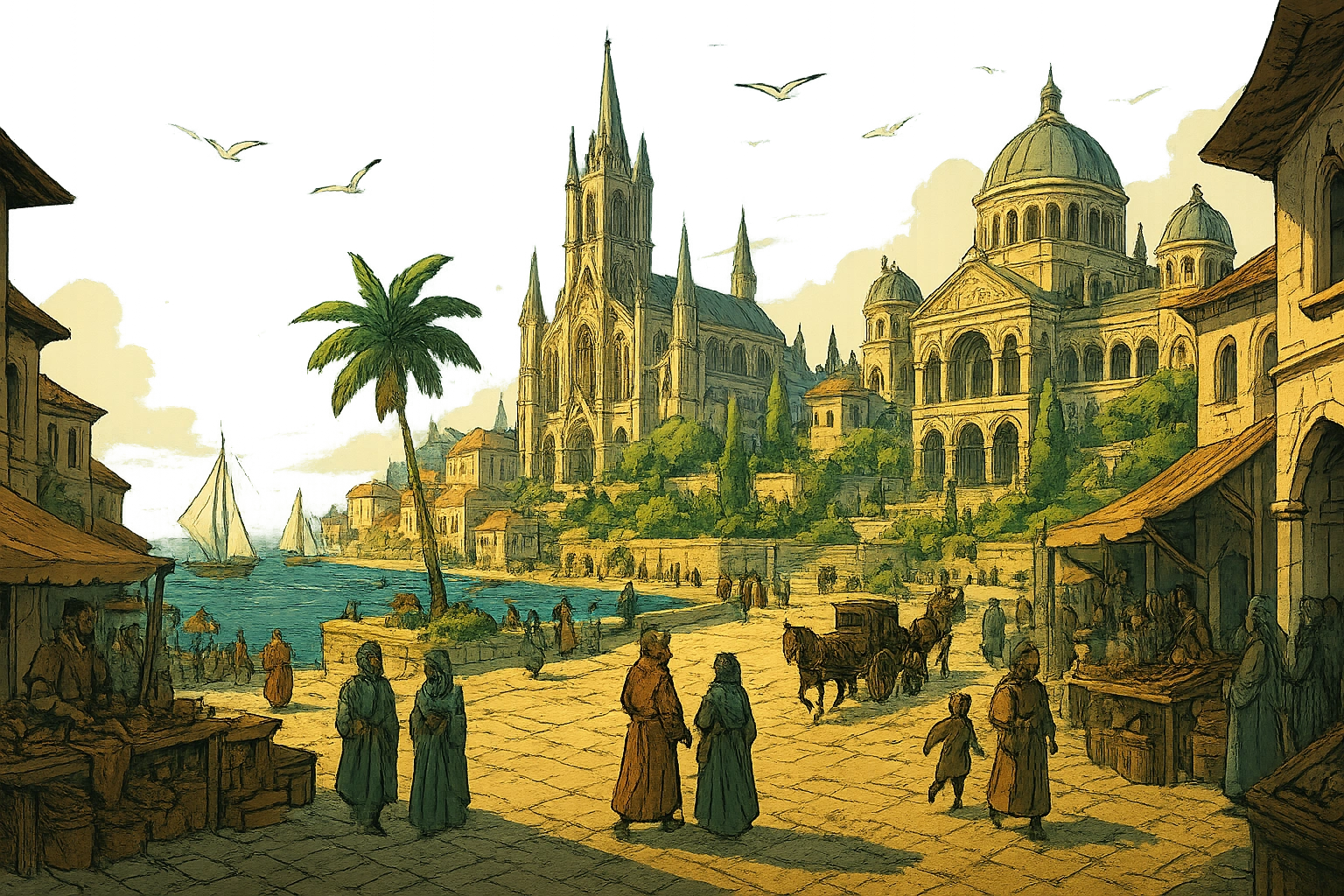
Overview
The Kingdom of Solara is the dominant human kingdom in the southern lands, founded in Year 0 of the Solaran Calendar following a prophetic vision by Saint Calros. Named for the sun and the enlightenment it represents, Solara has grown from a coastal city-state into a vast kingdom spanning from the Seawatch coast through the fertile Windcrest Valley. The kingdom is built on the twin pillars of Elandria’s light and Orithon’s order, with Church of Elandria serving as its spiritual foundation.
Solara is a land of culture, scholarship, and prosperity, where art and architecture flourish under royal patronage and the Church’s guidance. Yet beneath its gilded surface lie tensions: noble houses vie for power, the Church’s influence grows ever stronger, and dissenters flee to places like Lusteris in search of freedom from Solaran authority.
History
The Prophecy and Founding (Year -100 to 0)
In Year -100, Church of Elandria consolidated various Elandrian sects into a unified religious power, establishing its hierarchy of saints and sacred orders. As the Church grew in influence, it sought a temporal power that would embody its ideals of enlightenment and civilization.
In Year 0, Saint Calros, Patron of Truth, received a divine vision from Elandria herself. The prophecy declared: “A new age of light and prosperity will dawn under the Kingdom of Solara, where truth and justice shall reign eternal.”
Inspired by this vision, nobles and clergy gathered in the coastal city of Solaris to establish a kingdom dedicated to Elandria’s principles. They crowned King Aldric I Solborn as the first monarch, and the Solaran Calendar began. The prophecy seemed to come true almost immediately—the kingdom prospered, trade flourished, and culture bloomed under the Church’s guidance.
Early Expansion (Year 1-300)
The first three centuries of Solaran rule were marked by peaceful expansion and cultural golden age:
- Art, music, and scholarship flourished under royal and Church patronage
- The Great Library of Solaris was established
- Church of Elandria became the state religion, with temples in every major settlement
- Coastal trade routes connected Solara to distant lands
- The kingdom expanded westward slowly along the coast
The Windcrest Expansion (Year 300-500)
As Solara’s population grew, the kingdom looked northward to the fertile but largely unsettled Windcrest Valley. Scout expeditions discovered the Aramond River, named after Aramond the Watcher, a legendary ranger who first mapped the region.
Around Year 400, Solara established Aramond’s Lookout as a strategic waystation on the river, monitoring northern approaches and providing a base for further expansion. Over the following centuries, settlers moved into the valley, establishing farms, villages, and trading posts.
The Age of Lordships (Year 500-900)
As Solara expanded, the Crown established a system of lordships to govern distant territories:
- Lords were granted authority over specific regions in the King’s name
- Most lords were nobles who had distinguished themselves in service to the Crown or Church
- Lords collected taxes, administered justice, and maintained order
- In exchange, they owed fealty, taxes, and military support to the Crown
Major lordships established during this period included:
- Seawatch - protecting the southern coastal approaches
- Thornhaven - guarding the northern borders
- Various smaller holdings throughout the Windcrest Valley
The Founding of Southaven (Year 967)
The settlement at Aramond’s Lookout grew steadily, becoming a crucial trading hub between coastal Solara and the northern territories. In Year 967, King Aldric VII officially chartered the town as Southaven - “the haven south of the Elfwood.”
The Kael family, who had served as stewards of the region for generations, were elevated to Lords of Southaven. This lordship quickly became one of the kingdom’s most important, controlling trade routes and serving as the first line of defense against northern threats.
The Lusteris Secession (Year 1056)
Not all Solarans embraced the Church’s growing influence and the Crown’s expanding authority. In Year 1056, a group of dissidents (scholars, merchants, and freethinkers) left Solara for the harsh desert near Deadlands. Against all predictions, they successfully established Lusteris, a free city that rejected both Crown and Church authority.
King Marcus II declared the Lusterians traitors, but military campaigns to reclaim them failed in the brutal desert heat. Eventually, pragmatism won out: Lusteris became a valuable trading partner, and an uneasy peace was established. Many Solarans still view Lusteris with suspicion, seeing it as a haven for heretics and rebels.
Modern Era (Year 1100-Present)
The kingdom has continued to grow and prosper, though new challenges emerge:
- The Witchwood became corrupted in Year 1097, creating a dangerous barrier south of Southaven
- Trade with Lusteris has grown despite official disapproval
- Relations with the elven territories of Balandel and Vel Enweir have strengthened
- Rumors of cult activity have increased in recent decades
- Some nobles quietly resent the Church’s ever-growing influence over royal policy
Government and Structure
The Monarchy
Solara is ruled by an absolute monarch who claims authority from both bloodline and divine mandate. The current ruler is King Aldric IX Solborn, who ascended to the throne in Year 1245. The Solborn dynasty has ruled unbroken since the kingdom’s founding, though succession has occasionally been contentious. The King rules from Solaris, the capital city, where the royal palace stands adjacent to the Grand Cathedral of Elandria, a physical representation of the intertwined nature of Crown and Church.
The Church’s Role
Church of Elandria is not merely the state religion, it is woven into every aspect of Solaran governance:
- The Luminarch (High Priest of Elandria) of Solaris serves as the King’s chief spiritual advisor
- Church courts handle matters of theology, marriage, and moral law
- Temples serve as centers of education, healing, and charity
- The Church’s approval is required for noble marriages and succession
- Religious festivals are national holidays
This close relationship has brought stability and prosperity, but also criticism. Some nobles believe the Church holds too much power, while commoners sometimes resent the Church’s wealth and influence.
The System of Lordships
Solara’s vast territory is divided into lordships, each governed by a noble lord who rules in the King’s name. The system works as follows:
Duties of a Lord:
- Administer justice within their territory
- Collect taxes and tithes (a portion goes to the Crown, a portion to the Church)
- Maintain roads, infrastructure, and public order
- Raise and command local militia in times of war
- Enforce royal decrees and Church doctrine
- Protect their lands from external threats
Rights of a Lord:
- Hereditary title (passes to eldest child, usually son, with Church approval)
- Authority to issue local ordinances (subject to royal review)
- Right to trial by their peers in the Royal Court
- Access to the King’s court and participation in the Council of Lords (for major lordships)
- Ability to appoint local officials, knights, and administrators
Major Lordships:
| Lordship | Lord | Notes |
|---|---|---|
| Southaven | Lord Elrin Kael | Controls northern trade routes, guards against threats from the north |
| Seawatch | Lord Elrin Kael | Protects southern coastal approaches, manages maritime trade |
| Sunset Bluff | Lady Sylenna Thornbrook | Western coastal city |
Beneath the major lords are numerous minor nobles, landed knights, and baronets who control smaller territories. These nobles owe fealty to a major lord, who in turn owes fealty to the Crown. This feudal hierarchy ensures that even distant villages fall under Solaran authority.
Major Cities and Settlements
Solaris (Capital)
Population: ~80,000
The shining jewel of the kingdom, Solaris is built along the coast with white marble architecture that gleams in the sunlight. The city is divided into distinct quarters:
Southaven
Population: ~8,000
Once a humble outpost, Southaven has grown into a prosperous town and crucial trading hub. Located on the Aramond River in the Windcrest Valley, it serves as the northern gateway to Solara and the last bastion of “civilization”. The town is currently under siege by goblin raiders and cultists (Year 1267, Seventh Month).
Seawatch
Population: ~12,000
A fortified coastal city built into seaside cliffs, Seawatch serves as Solara’s primary naval base and southern guardian. Its lighthouse is visible for miles, guiding ships safely to harbor. The city is known for its shipyards, fishing industry, and the prestigious Naval Academy.
Sunset Bluff
Population: ~6,000
A small but wealthy coastal city overlooking the ocean. Ruled by Lady Sylenna Thornbrook has been